
Eastern Himalayas & Bengal Tour
- 15 Days
-
Destination Covered
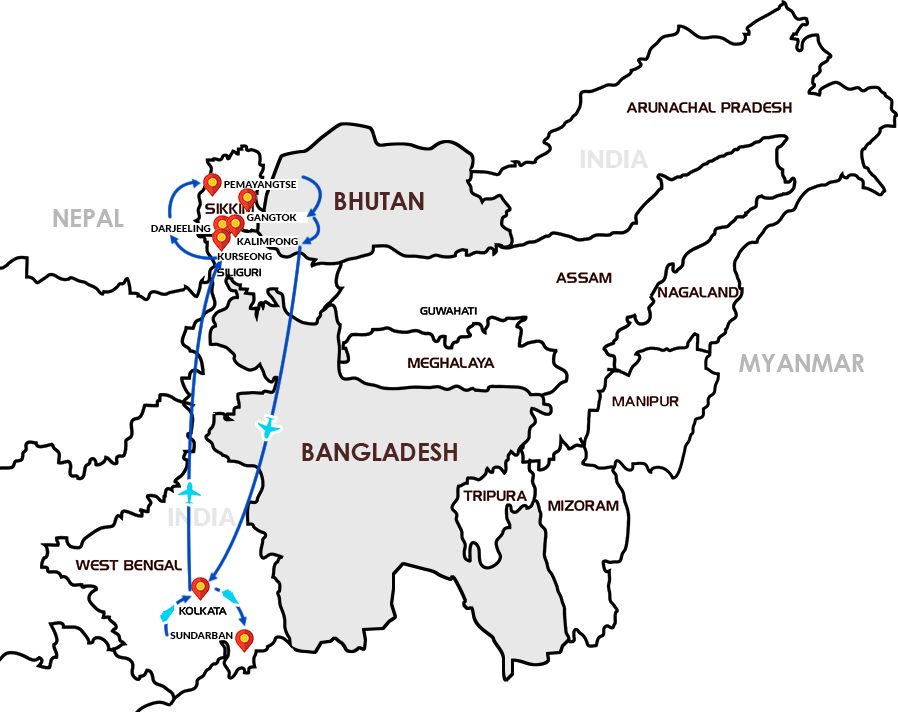
Kolkata, Darjeeling, Kalimpong, Gangtok & Sundarbans
This tour aims at showcasing two of the unique natural heritage of northeast & Bengal, one being the eastern Himalayas and their influences on people and culture along with a visit to the world’s largest delta of mangrove forests.
Kurseong: Ani gumph only women-run monastery in Darjeeling hills Sikkim also have a firsthand “tea garden visit” experience where tea history in the region dates back to 1849.
Darjeeling: Tibetan refugee self-help center rehabilitation center for Tibetan refugees who had fled hearth & home & providing them with means of livelihood. Also, experience a toy train joy ride one of the unique mountain railway projects which is now a world heritage that has been running since 1878.
Pemayangtse: Pemayangtse monastery is amongst the oldest & premier monasteries located in west Sikkim, following the Nyingma order of Tibetan Buddhism. Also, visit the absentee ruins which were the former capital of the kingdom of Sikkim from 1670 to 1814.
Kewzing Village: Kewzing to doling monastery visit a sneak into the diverse cultivation practices.
Gangtok: Excursion trips to “rey mindu lepcha village”, the “ lepchas” are believed to be the aboriginal tribes of sikkim.
Kalimpong: Local market walk to witness the colorful life of the local inhabitants along with a visit to st. Teresa’s church was built in 1929 resembling a Buddhist monastery.
Sundarbans: Bono-bibi-pala is age old tradition or practice of invoking the goddess Bono-bibi to seek blessings through narrative verses & songs.
Kolkata: Cuisine or book market or heritage tour a way to look closer into the colorful milieu that Kolkata exhibits.
Highlights:
- Tea Plantation Tour
- Village Life Experience
- Wild Life Experience
- Tribal Life Tour
- Heritage Tour Buddhism
Itinerary:
Welcome on arrival in Kolkata by Singapore Airlines and transfer to the hotel. Kolkata is the city of joy, contrast, and culture. Once the capital of British India – now the capital of West Bengal. A visit to kolkata will bring visitors in touch with a combination of a rich 400 years old heritage, vibrant modern life, and different cultures.
Morning free till departure, transfer to nscb airport to connect your flight to Bagdogra. Welcome on arrival at Bagdogra and transfer to kurseong (55kms / 02 hrs). Check-in at the hotel. Evening free for individual activity and leisure. Overnight at the hotel.
Kurseong is locally known as “kharsang”, which in Lepcha means ‘the land of white orchids’, referring to the small white orchids prolific here. The serenity and tranquility of this place are what attract people. On the outskirts of the main town of kurseong is Cochrane place, a recreated and restored stately British colonial home of its previous resident, Percy john Cochrane, mbe. The stunning view of the tea garden along with the mountains and the foothill forests of the eastern Himalayas from this tea resort is enchanting.
Kurseong is locally known as “kharsang”, which in Lepcha means ‘the land of white orchids’, referring to the small white orchids prolific here. The serenity and tranquility of this place are what attract people. On the outskirts of the main town of kurseong is Cochrane place, a recreated and restored stately British colonial home of its previous resident, Percy john Cochrane, mbe. The stunning view of the tea garden along with the mountains and the foothill forests of the eastern Himalayas from this tea resort is enchanting.dantium cum accusamus ullam voluptatibus commodi numquam, error, est. Ea, consequatur.
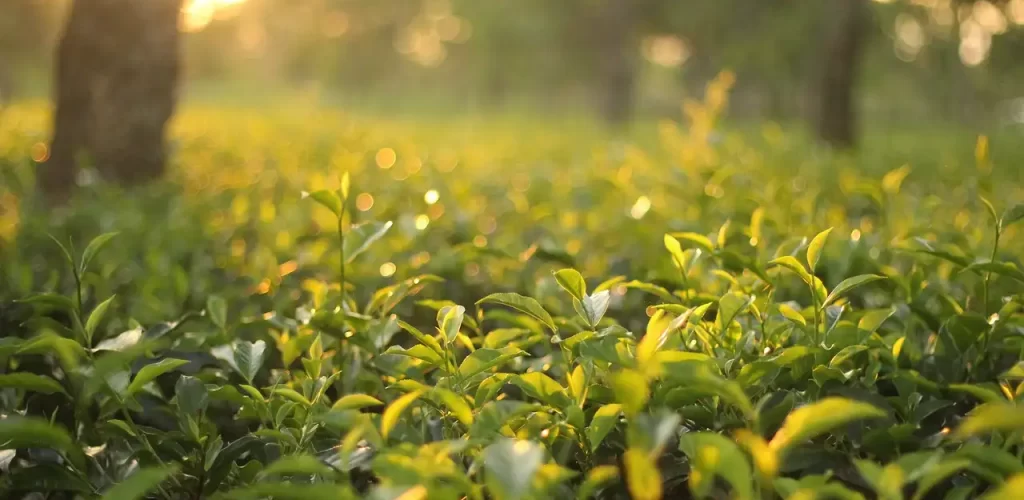
The morning after an early breakfast enjoy the tour of the Makaibari Tea Factory and Plantation to interact and discover the charming character, rich culture, and history with the friendly people of the tea estate.
Also visit the Ani Gompa in Kurseong, formerly known as Kunsamnamdoling Gompa, which stands out for being the only women-run Monastery, the Buddhist nuns are known as the “Ani’s”.
Lunch at Cochrane Place followed by transfer to the Kurseong Toy Train Station to connect Toy Train (Train 9D / STD 15.00Hrs) to Darjeeling (30Kms / 03Hrs). This unique Mountain Railway project was first started in 1878 by the initiative of Sir. Ashley Eden is now a World Heritage. Overnight at Darjeeling.
Darjeeling is a land of infinite variety and charm. Dorje, the mystic thunderbolt of the Lama Religion was the origin of the name Darjeeling, which was first discovered by a British Captain Lloyd in the year 1829. Surrounded by Tea gardens; this little town faces some of the highest peaks of the Himalayas and used to be the summer retreat of the European Officers in Bengal. Evening free for individual activity and leisure, overnight at Hotel.
Breakfast at the hotel followed by half-day local sightseeing covering padmaja n. The zoological garden (closed on thursday) was established on august 14, 1958. It specializes in breeding animals adapted to alpine conditions.
Himalayan mountaineering institute (closed on thursday) was founded in darjeeling on4th november by pandit nehru who said that “the institute trains young men not only to climb himalayan peaks but also create in them an urge to climb peaks of human endeavor.” hmi has the oldest mountaineering museum of the country established in 1957.
Tibetan refugee self-help center (closed on sunday) was established on 1 october 1959, following the dramatic escape of his holiness the dalai lama, thousands of tibetans left their hearth and homes, fled to the neighboring countries to live as free human beings. The production of tibetan handicrafts is the center’s main activity.
You might also experience the famous toy train joy ride. This unique mountain railway’ project was first started in 1878 by the initiative of sir. Ashley eden is now a world heritage.
Evening enjoys a short walk across the mall and local market (closed on thursday). Overnight at the hotel.
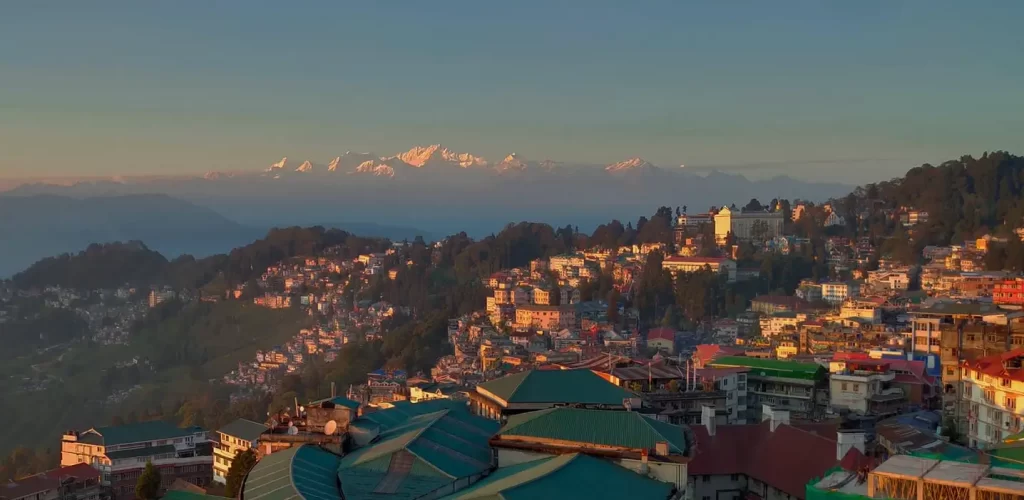
Early morning start for tiger hill to watch the spectacular sunrise and its amazing effects on the mt. Kanchendzonga (world’s 3rd highest peak) visit ghoom monastery and Natassia loop war memorial while returning to the hotel. Breakfast at the hotel followed by transfer to pemayangtse (pelling), (128kms/5hrs). Located at an altitude of 6,800 ft, pemayangtse is the nearest motorable point from mt. Kanchendzonga – the world’s 03rd highest peak offers a good sunrise and all-day-long view of the entire eastern himalayan range.
After an early breakfast at the hotel, take a short 03kms drive to the entrance of the rabdentse palace ruins the 2nd capital of sikkim. From here enjoy a 500-meter thrilling walk through the dense forest to the ruins of the palace which was founded by the 2nd chogyal of sikkim tensung namgyal in the year 1670 and subsequently destroyed by the invading nepalese army in 1814. The view from this place is breathtaking.
Walk back and visit the pemayangtse monastery (02kms) – the oldest monastery of sikkim established by lhatun campo, one of the revered lamas to have performed the consecration ceremony of the first chogyal (religious monarch) of sikkim. This monastery is meant only for ta – sang (pure) lamas. Lhatsun chhembo is
Believed to have described “Pure monks” thus monks of pure tibetan race, celibate and without any physical deformities. To the present day, it is only monks from pemayangtse who can enjoy the title “Ta-sang”.
Visit the khecheodpalri lake while driving back to Pema Yangtse which is about 7kms from the village. The lake is the holiest and wish-fulfilling. According to Buddhist belief, the lake is the emanation of the goddess Tara blessed by Guru Rimpoche. The miraculous part of the lake is that surface of the lake remains clean despite it being surrounded by thick forest.
Evening free for individual activity & leisure. Overnight at Pema Yangtse.
The morning after breakfast set out for kewzing. En route visit the tashiding monastery (35 kms / 1hr 30 mins approx) – belonging to the nyingmapa order and is highly revered among the people of Sikkim. Tashiding means “the devoted central glory” and the monastery by this name was founded in 1641 by ngadak sempa chemo phunshok rigzing who belonged to the Nyingma sect of tibetan Buddhism. It is believed that even a slight glimpse of the monastery can cleanse mortals of all sins.
Then proceed for kewzing km kms / 1.5 hrs) a typical Bhutia village rich in cardamom forest cover. Kewzing in the local Sikkimese Bhutia language means the “land of wheat fields” and is also known as sosing “land of the chestnut forest”. Overnight at kewzing.
The morning after breakfast proceed to uncover a few of the numerous trails that kewzing is famous for, specially kewzing to doling monastery, barfung, back him, and mambru villages where hikers get to experience the rich and diverse vegetation of Sikkim. The walks are along plain ridges with undulating elevation making the walks easy and less tiring. One can also see the unique cultivation practices and varied range of crops planted by the farmers of villages.
After the day’s visit reach Gangtok (further 60 km / 03 hrs approx.). The capital of the state of Sikkim is a beautiful and clean town promising the best monasteries and landscapes. Evening walks around the city to appreciate the new culture you are in. Overnight at the hotel.
Breakfast at the hotel and drive to rumtek monastery (24kms) one of the largest monastery in eastern Himalayas. It was constructed by his holiness in the late 16th Gyalwang Karmapa in 1960. It is the main seat of the Karma Kagyu lineage in Sikkim, “The dharmachakra center, a place of erudition and spiritual accomplishment, the seat of the glorious Karmapa.” a golden stupa contains the relics of the 16th Karmapa. Opposite that building is a college, Karma Shri Nalanda Institute for higher Buddhist studies.
Further 10 kilometers, visit the quaint ethnic Lepcha village of Rey mindu nestled below the fhambong lho wildlife sanctuary where traditional farming and its age-old cultural practices continue. Enjoy a slow walk across the lush paddy fields and the village and re-discover the 100 years old traditional Lepcha houses along with the
Karma karthen namgayling monastery and the lyakhyang (medicinal water pond). You might enjoy a traditional lepcha dance by the local artists followed by a traditional lunch. (optional). Later visit the Chorten or stupa built by the venerable truslshi Rimpoche, head of the Nyingma order of Tibetan Buddhism, in 1945. Institute of Tibetology (closed on Sunday) established in 1958 it is a treasure trove of a vast collection of rare Lepcha, Tibetan, and Sanskrit manuscripts, statues, and rare thankas and has over 200 Buddhist icons. Institute of handicrafts and handlooms (Closed on Sunday) while returning to the hotel, overnight.
Breakfast at the hotel drive to Kalimpong (80kms /02Hrs) – a quiet hill resort in the eastern Himalayas, Kalimpong is famous for its orchids & Nurseries where some of the rarest cacti and orchids can be seen.
Check in at the hotel and proceed for lunch. Afternoon experience the small Himalayan town starting from Durpin Dara (Hill Top] – a beautiful viewpoint from where small town and the surrounding hills can be enjoyed followed by Zong Dong Palri Fo-Brong Monastery situated beside which belongs to Gelukpa sect. After that proceed to Orchid Nursery followed by a visit to Guangdong Paper Industry which is a Handmade Paper Factory. Hand–made paper making is an ancient craft in the Himalayan hills which is seen mainly in local areas for religious printings of Buddhist scripts. This paper is environmentally friendly and produced from Daffney Flower which is widely found in abundance in the Eastern Himalayan region.
After visiting the Hand Made Factory we proceed to St Teresa’s Church for a quick look at a chapel built in 1929 resembling a Buddhist Monastery and overlaid with Tibetan Motifs. From this point, we proceed for a walking tour through the local market (Hath Bazaar) where you can experience the colorful life of the local inhabitants of this tiny Himalayan Town. Return to hotel and free till dinner.
This morning after late breakfast transfer to Bagdogra airport (65kms/02hrs) to return to connect your flight to kolkata. Welcome on arrival at kolkata and transfer to the hotel. Evening free for individual activity and leisure, overnight at hotel.
Kolkata is the city of joy, contrast, and culture. Once the capital of British India – now the capital of West Bengal. A visit to kolkata will bring visitors in touch with a combination of a rich 400 years old heritage, vibrant modern life, and different cultures.
Morning at 7 transfers to gothkhali (125kms/3hrs) through beautiful countryside and rural bazaar. Arrive at gothkhali jetty and board the motorized boat. After briefing and interpretation by our local guide cum naturalist over tea/coffee/welcome drink, cruise through vidyadhari, durgaduani, and gumdi rivers to the sudhanyakhali watchtower and visit to sajnekhali interpretation center. Experience the island cruise and arrive at Bali island and check in to Tora.
Evening enjoys a session of Bono-bibi-palagaan.
The word “bon”, stands for the forest in Bengali & “bibi” originates from the Persian word lady or wife”, thus the word “Bono-bibi translates to “lady of the forest”. Whereas “pala”, stands for long narrative verses & gaan signifies “songs” in Bengali. The songs are rendered invoking the blessing of the goddess “Bono-bibi”, for whoever is venturing into the forests, considers seeking the blessing of the goddess, who over the years has become a focal point of faith amongst its worshippers, who have to trudge their way into the forests every single day for fetching livelihood in the means of wood, honey, fish & crabs, etc. A tradition that is exclusively practiced in the Sundarbans in the lower delta region of Gangetic West Bengal & Bangladesh & which has survived through the ages, with just handwritten manuscripts & oral demonstration.
The mythology & folklore of Bono-bibi is based on a complicated system of make-belief myths & faith that the locals abide by in times of distress and sure the deity embarks to protect the residents of the village including the animals.
Overnight at the camp.
Spend the morning at Bali Village, a typical Sundarban village, and interaction with the villagers to experience their lifestyle. Guests will experience farming, paddy husking, honey packing, fishing, and various occupations of the region. After lunch check out and transfer to the small vessel to reach Gothkhali Jetty and transfer to Kolkata by surface (120Kms/3Hrs).
Morning after breakfast start exploring the city of Joy with an introduction about the glory of Bengal, visit the Flower Market – a unique wholesale market of flowers which is situated in the bank of river Ganges near the famous Howrah Bridge and drive by the heritage buildings of Dalhousie Square. Explore the College Street Book Market by a hand pulled Rickshaw and enjoy a cup of Hot Coffee at the Famous “Indian Coffee House” which is running since 1942. Enjoy a traditional Bengali lunch at the famous “Aaheli” at The Peerless Inn.
After lunch visit the famous Kalighat Kali Temple – one of the 52 Shakti Peethas in India. In between you might also enjoy a short Tram Ride in the crowded streets of Kolkata. Explore St. Paul’s Cathedral, the first ‘Episcopal Cathedral Church’ in an oriental country followed by the Victoria Memorial also referred to as the Taj of the Raj. This splendid white marble structure was built in memory of Queen Victoria between 1906 and 1921 and was formally inaugurated by the Prince of Wales, who later became King Edward VIII of England. Your city experience will end at the Mother House – the headquarters of the Missionaries of Charity. Overnight at hotel.
BOOK MARKET VISIT
The Knowledge Street: Walk across the Book market of College Street – the intellectual hub of the City with a coffee break at the historical coffee house.
OR
KOLKATA HERITAGE TOUR
This tour starts from St. John’s Church and covers 15 historic colonial buildings surrounding the city square and ends at Kumartuli – the hub of the potters and clay idol-makers of Kolkata.
OR
FOOD WALK TOUR
Going by the popular saying that food is where the heart is, the notion is that nothing else connects you to a place than its food. Kolkata is known across for having invariable and incredible tastes owing to its many influences that it has taken over through decades and thus leading to inventions which food connoisseurs absolutely so love. Its called a melting pot having within its seam Chinese influences at Tiretta Bazar (Old China Town), to Awadhi Cuisine that made its way when Nawab Wajid Ali Shah of Oudh was exiled to Kolkata in the mid 1800’s, thus leading to the birth of the famous kebabs & lastly but not the least, the subtle Bengali Cuisine. Kolkata being called the Gastronomical capital of India, a peek into the food practices & cultures, will forever be etched in your memory.
Early morning departure transfer to NSCB Airport to connect flight for the journey towards onward destination.
TOUR ENDS.
Included/Excluded
- Luxury Accommodation on Twin Sharing basis
- English Speeking Guide
- Assistance on arrival at Kolkata
- Entry Fees Taxes except 5% Goods and Service Tax.
- All transfers and sightseeing as per itinerary by appropriate sized AC Vehicle.
- Personal Expenses such as Laundry, Telephone Calls, Alcoholic & Non-Alcoholic Beverages, Food(if not included).
- Additional sightseeing or usage of vehicle not mentioned in the itinerary.
- Any services not mentioned in the itinerary.
- High Season Surcharge.
- Air Tickets.
- 15 Days Tour
On Request

Explore other options
- Kolkata, Darjeeling, Kalimpong, Gangtok & Sundarbans
- 15 Days
- West Bengal, & Assam
- 13 Days
- West Bengal, Assam, & Meghalaya
- 17 Days