North East Culture & Wildlife Tour
- 17 Days
-
Destination Covered
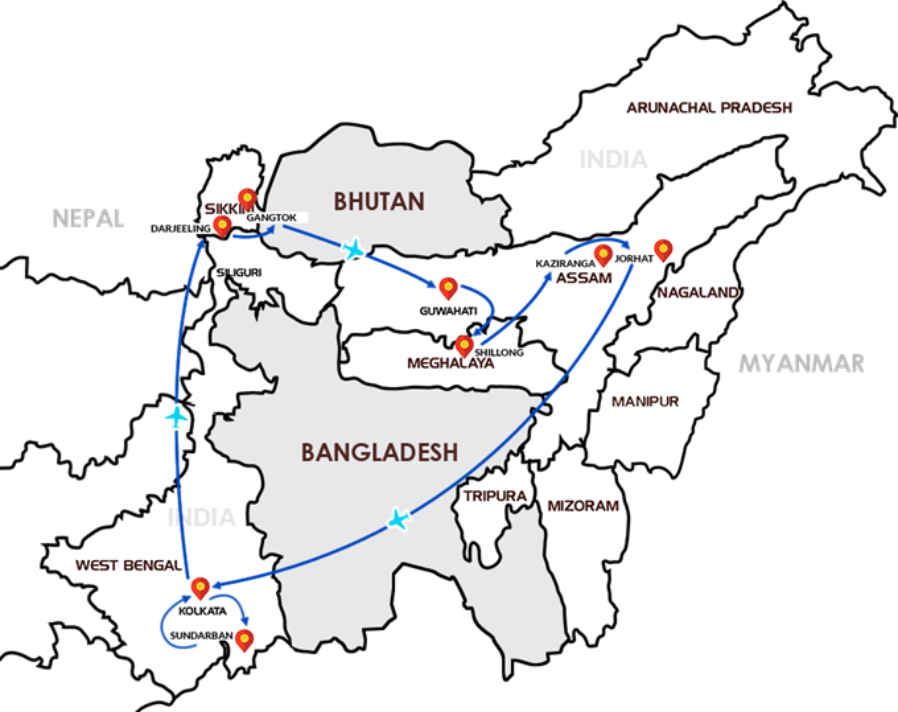
West Bengal, Assam, & Meghalaya
This tour aims to showcase the best of nature and wildlife in the northeastern region from the land of the famed one-horned rhino in Kaziranga to the land of royal Bengal tigers in Sundarbans.
Darjeeling
Tibetan refugee self-help centre rehabilitation center for Tibetan refugees who had fled hearth & home & providing them with means of livelihood. Also, experience a toy train joy ride one of the unique mountain railway projects which is now a world heritage that has been running since 1878.
Gangtok
Excursion trip to “Rey mind Lepcha village”, the “Lepchas” are believed to be the aboriginal tribes of Sikkim.
Shillong
Excursion trip to mawlynnong asia’s cleanest village & living root bridge trek.
Kaziranga
The national park is famed for hosting two-thirds of the world’s “great one-horned rhinoceroses”.
Jorhat
The Assam tea experience.
Sundarbans
Bono-bibi-pala age old tradition or practice of invoking the goddess bono-bibi to seek blessings through narrative verses & songs.
Kolkata
Cuisine or book market or heritage tour a way to look closer into the colorful milieu that Kolkata exhibits.
Highlights:
- Vibrant Tribal Communities
- Lively Local Villages
- Intangible Cultural Heritage
- Scenic Wilderness Trails
- Iconic World Heritage Sites
- Heritage Tea Trails
- River Life Experience
Itinerary:
Welcome on arrival in Kolkata by Singapore Airlines and transfer to the hotel. Kolkata is the city of joy, contrast, and culture. Once the capital of British India – now the capital of West Bengal. A visit to kolkata will bring visitors in touch with a combination of a rich 400 years old heritage, vibrant modern life, and different cultures.
Morning free till departure, transfer to NSCB airport to connect your flight to Bagdogra. Welcome on arrival at Bagdogra & transfer to Darjeeling (95kms/3hrs).
Darjeeling is a land of infinite variety and charm. Dorje, the mystic thunderbolt of the lama-religion was the origin of the name Darjeeling, which was first discovered by a British captain lloyd in the year 1829. Surrounded by
Tea gardens; this little town faces some of the highest peaks of the Himalayas and used to be the summer retreat of the European officers in Bengal. Evening free for individual activity and leisure, overnight at hotel.
Breakfast at the hotel followed by half day of local sightseeing covering padmaja n. Zoological garden (closed on thursday) established on august 14, 1958. It specializes in breeding animals adapted to alpine conditions.
Himalayan mountaineering institute (closed on thursday) was founded in darjeeling on4th november by pandit nehru who said that “the institute trains young men not only to climb himalayan peaks but also create in them an urge to climb peaks of human endeavour.” hmi has the oldest mountaineering museum in the country established in 1957.
Tibetan refugee self-help center (closed on sunday) was established on 1 october 1959, following the dramatic escape of his holiness the dalai lama, thousands of tibetans left their hearth and home, fled to the neighboring countries to live as free human beings. The production of tibetan handicrafts is the center’s main activity.
Evening enjoys a short walk across the mall and local market (closed on thursday). Overnight at the hotel.
Early morning start for tiger hill to watch the spectacular sunrise and its amazing effects on the mt. Kanchendzonga (worlds 3rd highest peak), visit ghoom monastery and batasia loop war memorial while
Returning to the hotel. Breakfast at the hotel followed by transfer to gangtok (further 105 kms / 04 hrs approx.). The capital of the state of sikkim is a beautiful and clean town promising the best monasteries and landscapes. Evening walks around the city to appreciate the new culture you are in. Overnight at the hotel.
Breakfast at the hotel and drive to rumtek monastery (24kms) one of the largest monastery in the eastern Himalayas. It was constructed by his holiness in the late 16th gyalwa Karmapa in 1960. It is the main seat of the Karma Kagyu lineage in Sikkim, “The dharmachakra center, a place of erudition and spiritual accomplishment, the seat of the glorious Karmapa.” a golden stupa contains the relics of the 16th Karmapa. Opposite that building is a college, Karma Shri Nalanda Institute for higher Buddhist studies.
Further 10 kilometers, visit the quaint ethnic Lepcha village of Rey mind nestled below the fhambong lho wildlife sanctuary where traditional farming and its age-old cultural practices continue. Enjoy a slow walk across the lush paddy fields and the village and re-discover the 100 years old traditional Lepcha houses along with the
Karma earthen namgayling monastery and the Lhakhang (medicinal water pond). You might enjoy a traditional Lepcha dance by the local artists followed by a traditional lunch. (optional). Later visit the Chorten or stupa built by the venerable truslshi Rimpoche, head of the Nyingma order of Tibetan Buddhism, in 1945. Institute of Tibetology (closed on Sunday) established in 1958 it is a treasure trove of a vast collection of rare Lepcha, Tibetan, and Sanskrit manuscripts, statues, and rare thankas and has over 200 Buddhist icons. Institute of handicrafts and handlooms (Closed on Sunday) while returning to the hotel, overnight.
The morning after breakfast departure/transfer to Bagdogra (114kms / 4.5hrs) to board your connecting flight to Guwahati.
Welcome on arrival at Guwahati. Situated on the south bank of the river Brahmaputra, this is the largest city of Assam, a major riverine port city, and one of the fastest-growing cities in India. Many ancient Hindu temples are in the city, giving it the name “City of temples” the most important being the kamakhya temple. Transfer to city hotel. Check-in at the hotel. Later proceed to visit “sankardeva kalakshetra” – a cultural institution in the Panjabi area, named after the medieval poet-playwright and reformer srimanta sankardev. Evening experience the river cruise on the river Brahmaputra. Overnight at Guwahati.
The morning after breakfast transfer to shillong (130kms /03 hrs). En route visit umium lake – which has been created by damming the umium river in the early 1960s. The principal catchment area of the lake and dam is spread over 220 square km. Shillong – the capital of british-created assam until 1972 – and is now the capital and hill station of meghalaya, also known as “The abode of clouds”, one of the smallest states in india. Check-in at hotel.
Later after freshening up proceed for local sightseeing in shillong, including the city’s own ward’s lake which is popular for short garden walks & boating. The botanical garden offers a plethora of indigenous and exotic plants & rare collection of orchids. “lady hydari park” is a japanese-style landscaped park endowed with stretches of roses & exquisite flowers. One of the largest golf courses in asia is an 18-hole golf course that is charted amidst a surging valley full of thick pine groves & rhododendron trees. The state museum is a display of the lifestyle and heritage of the people of meghalaya (closed on sunday). Shillong and its surrounding are dotted with splendid waterfalls cascading down deep valleys forming misty sparks as they break the silence of the surroundings. Transfer back to city hotel. Overnight at shillong.
After breakfast drive to mawlynnong, the cleanest village in Asia (100 km / 3 hrs drive approx), also known as ‘god’s garden’. With over 80 households, the village gives the ambiance of walking in a well-maintained park! Climb the 80 ft skywalk at mawlynnong village for a bird’s eye view of the village, the plantations, and the faraway plains of Bangladesh. You will also be acquainted with the Khasi lifestyle, culture, and economy.
A trek to the nearby Rewari village is another interesting activity. Walk down a flight of almost 100 steps to witness nature’s wonder, the living-root bridge. The bridges are tangles of massive thick roots, which the local people inter-twine to form a bridge that can hold several people at a time. The root bridges may be up to over a hundred feet long and take ten to fifteen years to become fully functional, but they become very strong in the process. The bridges live and keep growing and strengthening over time. The useful lifespan of the bridges is thought to be 500–600 years. Drive further 30 km from mawlynnong to reach dawki. Dawki, the name is famous because of international trade border town to Bangladesh. The drive to Dawkins is a beautiful drive along with the Bangladesh border, covered with betel nut trees, and a thrilling experience to drive around lots of waterfalls. You can see people from Bangladesh working and fishing in this river on the Indian border. Before reaching the bordering town you will come across this blue-water river which is known as the umngot river. Dawki village is known for limestone business and other international trade with Bangladesh and the weekly market allows people from both sides to tread their stuffs. Later proceed to Shillong for an overnight stay.
Note: it is advisable to carry packed lunch to mawlynnong.
Morning enjoys breakfast and then set out on an excursion trip to cherrapunjee (60 km / 2hrs one way) – credited to being the wettest place on earth. It is the traditional capital of the Songkhla Hima (Khasi tribal chieftainship) known as Zohra or churro. Visit the dwan system viewpoint, noh kalikai falls, mawsmai caves, seven sister falls, eco park, etc. Later drive back to Shillong. Overnight at Shillong.
The morning after breakfast transfer to Kaziranga (325kms / 07hrs). Kaziranga was declared a national park in 1974 and UNESCO declared Kaziranga a world heritage site in 1985. The park hosts two-thirds of the world’s population of rhinos.
Early morning go for an elephant ride in the park. (elephant riding time: 1st ride- 5.15-6.15 am; 2nd ride: 6.30-7.30 am) apart from the rhino, other species found are hog deer, swamp deer, wild buffalo, elephants, and if you are lucky, the tiger. It is virtually a paradise for bird watchers, with a variety of migratory and resident birds. It is also home to pelicans, storks, and darters as there are several water bodies inside the park.
After breakfast at the hotel, you can visit tea plantations and rubber plantations. Afternoon enjoys jeep safari in the central range. Evening at leisure. Overnight at Kaziranga.
The morning after breakfast transfer to jorhat (140kms/3.5hrs) & later transfer to any one of the heritage tea bungalows. Jorhat – also reckoned to be the cultural capital of assam, jorhat owes much to its history. It was the last capital of the ahom kingdom. Today jorhat has the largest tea research station in the country and therefore it is now known as the tea capital of india.
Later proceed to visit one of these lush green & tranquil tea estates. Be a part of the uniqueness that this part of india has to offer & savor the very best.
See the colorful women pluckers as they chatter and sing while meticulously plucking the freshest two leaves-and-a-buds from the bushes. Enter the factory and get first-hand knowledge of how tea is made. Learn the art of tea-tasting from the masters. A fascinating story that begins in the bush and ends in your cup! Further, these tea estates also have golf courses attached to them. Most of them are 9 hole golf courses. The guests can also have post-golf sessions at some of the classic clubhouses.
The morning after breakfast transfer to jorhat (140kms/3.5hrs) & later transfer to any one of the heritage tea bungalows. Jorhat – also reckoned to be the cultural capital of assam, jorhat owes much to its history. It was the last capital of the ahom kingdom. Today jorhat has the largest tea research station in the country and therefore it is now known as the tea capital of india.
Later proceed to visit one of these lush green & tranquil tea estates. Be a part of the uniqueness that this part of india has to offer & savor the very best.
See the colorful women pluckers as they chatter and sing while meticulously plucking the freshest two leaves-and-a-buds from the bushes. Enter the factory and get first-hand knowledge of how tea is made. Learn the art of tea-tasting from the masters. A fascinating story that begins in the bush and ends in your cup! Further, these tea estates also have golf courses attached to them. Most of them are 9 hole golf courses. The guests can also have post-golf sessions at some of the classic clubhouses.
Morning at 7 transfers to gothkhali (125kms/3hrs) through beautiful countryside’s and rural bazaar. Arrive at gothkhali jetty and board the motorized boat. After briefing and interpretation by our local guide cum naturalist over tea/coffee/welcome drink, cruise through the vidyadhari, durgaduani, and gumdi rivers to the sudhanyakhali watchtower and visit to sajnekhali interpretation center. Experience the island cruise and arrive at Bali island and check in to Tora.
Evening enjoys a session of Bono-bibi-Palagan.
The word “bon”, stands for the forest in bengali & “bibi” originates from the Persian word lady or wife”, thus the word “Bono-bibi translates to “lady of the forest”. Whereas “pala”, stands for long narrative verses & gaan signifies “songs” in Bengali. The songs are rendered invoking the blessing of goddess “Bono-bibi”, for whoever is venturing into the forests, considers seeking the blessing of the goddess, who over the years has become a focal point of faith amongst its worshippers, who have to trudge their way into the forests every single day for fetching livelihood in the means of wood, honey, fish & crabs, etc. A tradition that is exclusively practiced in the Sundarbans in the lower delta region of Gangetic West Bengal & Bangladesh & which has survived through the ages, with just manuscripts & oral demonstration.
The mythology & folklore of Bono-bibi is based on a complicated system of make-belief myths & faith that the locals abide by in times of distress and sure the deity embarks to protect the residents of the village including the animals. Overnight at the camp.
Spend the morning at bali village, a typical sundarban village, and interact with the villagers to experience their lifestyle. Guests will experience farming, paddy husking, honey packing, fishing, and various occupations of the region. After lunch check out and transfer to small vessel to reach gothkhali jetty and transfer to kolkata by surface (120kms/3hrs).
The morning after breakfast start exploring the city of joy with an introduction to the glory of Bengal, visit the flower market – a unique wholesale market of flowers which is situated on the bank of the river Ganges near the famous Howrah Bridge and drive by the heritage buildings of Dalhousie square. Explore the college street book
Market by a hand-pulled rickshaw and enjoy a cup of hot coffee at the famous “Indian coffee house” which is running since 1942. Enjoy a traditional Bengali lunch at the famous “aaheli” at the peerless inn.
After lunch visits the famous kali ghat kali temple – one of the 52 shakti peethas in India. In between, you might also enjoy a short tram ride in the crowded streets of kolkata. Explore st. Paul’s cathedral, the first ‘episcopal cathedral church’ in an oriental country followed by the victoria memorial also referred to as the taj of the raj. This splendid white marble structure was built in memory of queen victoria between 1906 and 1921 and was formally inaugurated by the prince of wales, who later became King Edward viii of England. Your city experience will end at the motherhouse – the headquarters of the missionaries of charity. Overnight at the hotel.
Book market visit: the knowledge street walk across the book market of college street – the intellectual hub of the city with a coffee break at the historical coffee house.
Or
Kolkata heritage tour: this tour starts from st. John’s church covers 15 historic colonial buildings surrounding the city square and ends at Kumar Tuli – the hub of the potters and clay idol-makers of kolkata.
Or
Food walk tour: going by the popular saying that food is where the heart is, the notion is that nothing else connects you to a place than its food. Kolkata is known for having invariable and incredible tastes owing to the many influences that it has taken over through decades and thus leading to inventions that food connoisseurs so love. Its called a melting pot having within its seam Chinese influences from tiretta Bazar (old china town), to Awadhi cuisine that made its way when Nawab Wajid Ali Shah of Oudh was exiled to kolkata in the mid-1800s, thus leading to the birth of the famous kebabs & lastly but not the least, the subtle Bengali cuisine. Kolkata is called the gastronomical capital of India, a peek into the food practices & cultures, will forever be etched in your memory.
Early morning departure transfer to nscb airport to connect flight to frankfurt. Tour ends.
Included/Excluded
- Luxury Accommodation on Twin Sharing basis
- English Speeking Guide
- Assistance on arrival at Kolkata
- Entry Fees Taxes except 5% Goods and Service Tax.
- All transfers and sightseeing as per itinerary by appropriate sized AC Vehicle.
- Personal Expenses such as Laundry, Telephone Calls, Alcoholic & Non-Alcoholic Beverages, Food(if not included).
- Additional sightseeing or usage of vehicle not mentioned in the itinerary.
- Any services not mentioned in the itinerary.
- High Season Surcharge.
- Air Tickets.
- 13 Days Tour